
The Architecture of Human Capacity
From individual capacity to organisational design
By Kjersti S. Kristensen, Rune Aa. Halvorsen, June 2026
Ideas in Brief
The Opportunity - Many organisations have untapped human capacity. The constraint is rarely talent. It is the environment surrounding people, which either enables or restricts what they can do. That environment is usually possible to change.
The Insight - The environment works through signals. Every decision, process, and standard an organisation operates sends a continuous message to the people inside it: whether they are safe and whether they matter. Those two questions determine how clearly people think, how well they collaborate, and how much they contribute.
The Implication - Most leaders ask how to motivate their people. The better question is what the organisation itself is teaching people to expect, because structures and routines shape behaviour long before any motivational effort reaches them.
What Leaders Should Do - Start by building awareness of your own signals, and of what the environment is actually doing to the people inside it. Diagnose what the organisation is actually signalling. Build on what is already working and address the places where the system is working against itself. And lead with steadiness because a leader's own presence under pressure is one of the strongest signals the organisational environment sends.
What Drives Human Capacity
Most leaders look at human performance through a people lens: talent, motivation, resilience, effort. In our earlier work, Unlocking Human Potential: The Biology of High Performance, we showed that human capacity rises and falls based on the answers to two questions the nervous system asks continuously:
Am I Safe? (physical · emotional · psychological safety)
Do I Matter? (contribution · recognition · belonging)
These questions are answered in real time by the amygdala, the brain's threat-detection centre. When the answers are yes, the nervous system settles into Safe Mode: the prefrontal cortex is online, thinking is clear, collaboration is possible, and people can access the full range of what they are capable of. When the answers are uncertain or no, the amygdala takes over. The person enters Protection Mode: hyper-vigilant, reactive, cognitively contracted. Biology does not allow talent, training, or motivation to override that state. And those questions are answered not by leaders alone but by everyone, through every decision-making process, feedback loop, workload expectation, and governance structure that shapes the daily experience.
Walk into any high-performing team, and you will find a kind of ambient clarity. People know what they are working toward. They raise problems without bracing for consequences. They trust the process enough to take risks. That clarity is the product of a well-designed environment, one that sends coherent signals about what matters, who decides, how mistakes are handled, and whether people belong. When an organisation gets those signals right, it keeps things running and actively enables people to access more of what they are capable of.
Organisations are living systems: dynamic, interdependent, and continuously shaped by the interactions between their parts. Employees and the organisation form one system, each continuously shaping and shaped by the other. You cannot understand human capacity by looking only at the employee, any more than you can understand a plant by ignoring the soil it grows in.
This article examines that organisational environment, the architecture of conditions surrounding every person at work, as the most powerful lever leaders have for unlocking what their people are genuinely capable of.
The Environment
Every person arrives at work already shaped by forces far beyond the organisation's reach: family, health, finances, relationships, world events. The environment is the totality of context surrounding a person, inside and outside work, continuously sending signals the nervous system must process, constantly answering the same two questions: Am I safe? Do I matter?
Leaders can directly influence only one part of that environment: the organisational layer. The forces outside work, a difficult relationship, financial pressure, and a loss not yet processed, are real, and they shape the state a person brings through the door each morning. A leader cannot design that part of the environment. A leader can ensure that what happens inside the organisation actively helps to offset it. That is a strategic responsibility. The people who arrive carrying the most are precisely the ones who need the organisational environment to be coherent.
There is a five-hundred-year-old drawing that captures this relationship more precisely than any modern diagram. Leonardo da Vinci's Vitruvian Man shows a human figure inscribed within both a circle and a square simultaneously. The figure is the person: their biology, their needs, their capacity. The circle is the living system: the relational, informal environment that surrounds them. The square is the outer structure: the formal, designed organisational layer. The person lives inside both at once, shaped continuously by both. When they are coherent, human capacity flourishes.
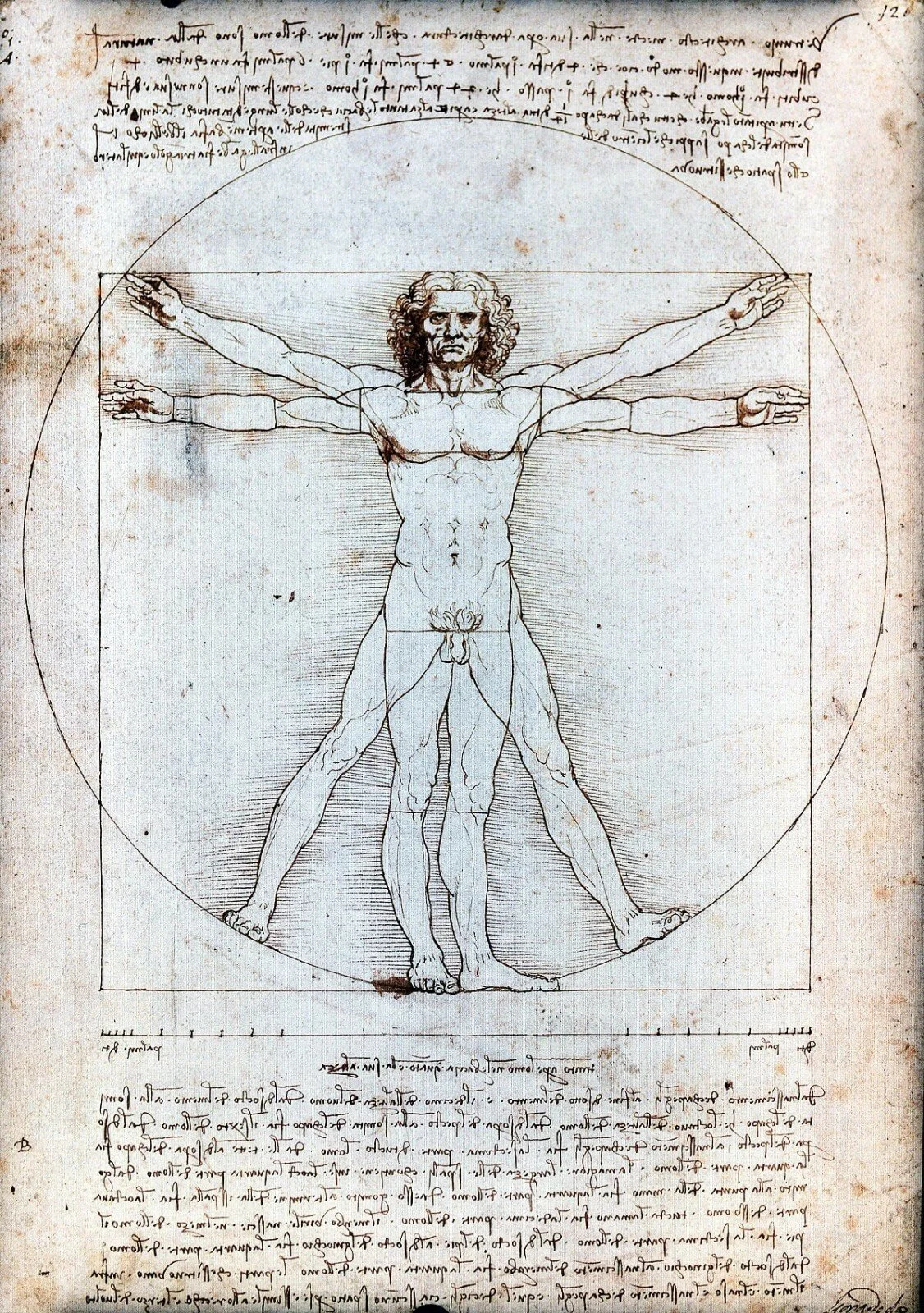
That same relationship can be seen in the Ignited Model: the person as the inner loop, the living system as the relational environment surrounding them, and the outer structure as the formal organisational layer containing both. The inner loop and the living system are explored in our earlier work, Unlocking Human Potential: The Biology of High Performance.
The organisational layer, both its formal structure and its relational dynamics, is the focus of what follows.
Most organisations already have governance frameworks, risk processes, compliance standards, and performance systems. Most also have culture programmes and engagement initiatives. The connection between the two is rarely mapped. The structural domains are the mechanism that produces culture. An unclear decision right, an inconsistently applied standard, an unmanageable workload — these cause low psychological safety directly, operating through a specific, predictable biological pathway. The human experience is shaped by decisions that most leaders file under strategy, governance, or operations — not people. Which is exactly why working on the people side alone rarely fixes it.
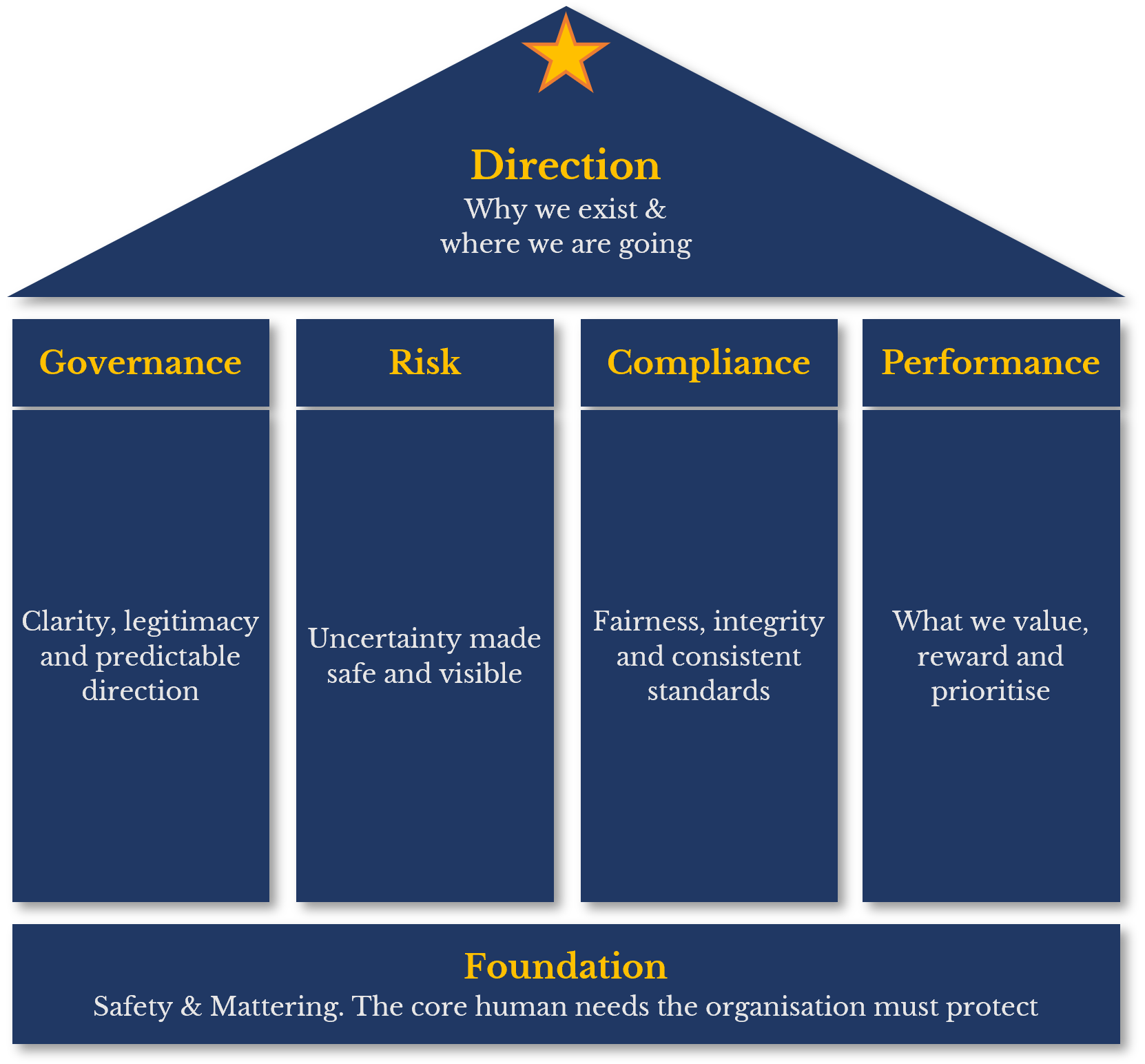
The organisational layer operates through two distinct but interconnected systems. The Outer Structure is the formal, designed layer: direction, governance, risk, compliance, and performance. These can be audited, measured, and deliberately redesigned. The Living System is the informal, relational layer: the dialogue, the tone, the way a leader shows up in a difficult moment, the unwritten norms that shape how people treat each other. This layer is harder to measure but equally real in its effect on human capacity.
Both layers send signals. Both answer the same two questions. A structural condition like unclear decision rights, and a relational condition like absent recognition, operate through the same biological pathway — both tell people whether they are safe and whether they matter. Designing for human capacity means working on both layers, not just the one that appears on an organisational chart.
The foundation beneath all five domains is always the same two core human needs: safety and mattering. They are biological imperatives, the load-bearing base on which everything else rests. They are also the precise point where the outer structure meets the person's internal experience.
A governance or compliance professional and an HR director would normally read these five domains separately, each through their own function. Here they are read through a single lens: what they do to the person inside them. Each either protects the two core needs or erodes them. That is the lens through which to read what follows.
Direction — purpose, priorities, and forward momentum
When direction is clear and consistent, people move coherently without needing constant management. They understand how their work connects to something larger, and that connection is what sustains motivation and quality over time. You know it is missing when three people in the same meeting give three different answers to the question: What are we actually trying to achieve this year? Everyone nods. No one resolves it. People leave and carry on doing whatever they were doing before.
Governance — clarity, legitimacy, and decision-making that people trust
Good governance removes the cognitive load of constant interpretation. When decision rights are clear and communication is transparent, people redirect the energy they would have spent on ambiguity into the work itself. You know it is missing when you have spent more energy working out who actually makes the decision than making it — or when a decision you thought was made gets quietly reversed, and no one tells you why.
Risk — making uncertainty safe and problems visible
Organisations that handle risk openly are more resilient and innovative. When people can raise concerns without fear, problems surface early and cheaply. Mistakes become data rather than liabilities. You know it is missing when you have known something was going wrong for weeks and said nothing — because you had seen what happened to the last person who raised a concern. The problem surfaced anyway. It was just bigger by then.
Compliance — protecting fairness, integrity, and the trust of the system
When one standard is applied fairly and consistently, people stop expending energy on political vigilance and redirect it toward contribution. Coherent compliance signals that the organisation can be trusted and that trust is the foundation on which everything else is built. You know it is missing when the rules seem to apply differently depending on who you are or which team you sit in. You stop trying to understand the system and start trying to navigate it instead.
Performance — recognising, rewarding, and sustaining what people contribute
When workloads respect human limits, roles match competence, and recognition is regular and genuine, people operate with confidence and steadiness. Sustainable performance is not a constraint on ambition — it is the precondition for it. You know it is missing when you have delivered something you were genuinely proud of and heard nothing. Or when performance only comes up when something goes wrong. Over time, you stop going the extra distance — not because you stopped caring, but because the signal told you it did not matter.
Together, the five domains form a single system. When they reinforce each other, the effect is cumulative: people can show up to work carrying less friction, and that freed-up capacity redirects toward exactly the qualities — creativity, collaboration, judgment, care — that organisations actually need.
The effect compounds. People who are guessing less, hiding less, bracing less, and burning out less are measurably more capable, not just more comfortable. The energy that would have gone into self-protection becomes available for the work itself. The shift is measurable, not just felt.
“The organisational environment is one of the most powerful determinants of human performance.”
The Signal Language of the Organisational Environment
Across both layers of the organisational environment, specific conditions act as ignitors or diminutors, concepts we have developed as part of the Ignited Model. Ignitors are signals that strengthen safety and mattering, expanding capacity. Diminutors are signals that undermine safety and mattering, contracting capacity.
You have probably felt both. A manager who walked over, looked at what you were doing, and said: that was really well handled — and meant it. A team where you could say 'I don't know' without bracing for consequences. A role where your work had visible impact, and someone noticed. Those are ignitors. Small, consistent, and cumulative.
You have also felt the other side. A priority that changed for the third time in a month, with no explanation. A process that applied differently depending on who was involved. A workload that had been unsustainable for so long that unsustainable had become normal. Feedback that only arrived when something went wrong. Those are diminutors. Their power lies precisely in the fact that none of them, individually, seems like a crisis.
The important insight about diminutors is that they do not need to be dramatic to be damaging. The nervous system does not distinguish between a physical threat and an ambiguous performance review. Chronic diminutors keep people in Protection Mode, where creativity, collaboration, and sound judgment quietly recede. Organisations lose exactly the capacity they most need, without ever knowing why.
The same is true in the other direction, and less often discussed: persistent, low-grade ignitors compound upward. A team that experiences consistent direction, fair governance, and genuine recognition over time accumulates trust, adaptive capacity, and creative bandwidth. It pays dividends in exactly the moments when circumstances are most demanding.
“Organisations rarely unlock potential through one dramatic intervention. They build it through a thousand small consistencies.”
When the Environment Holds
When organisational signals are coherent over time, something important happens: the nervous system learns that the environment can be trusted. People move out of Protection Mode and into Safe Mode, where clear thinking, openness, and full contribution become possible again. This is a neurological shift, not only a cultural one.
When signals become inconsistent, people drift back toward Protection Mode, more reactive, less patient, less able to hold the perspective of others.
Recovery takes time because the nervous system must relearn that the environment is reliably safe. Teams oscillate between contraction and expansion as they test whether new signals can be trusted. A leader who begins communicating more clearly will not immediately see improved performance, because the nervous system does not respond to a single signal. It responds to a pattern. Consistency over time is the only thing that rebuilds trust.
You will recognise this if you have ever worked somewhere that went through a difficult period, a restructure, a leadership change, a period of real pressure, and then tried to rebuild. The new leader communicates more openly. The new process is fairer. People hold back. They have learned, through experience, not to trust the first signal. They are waiting to see if it holds. That is the nervous system doing exactly what it is designed to do — protecting the person until the pattern is clear.
This is why sustaining change to the organisational environment matters. Trust is earned through repetition, and what the organisational environment consistently signals is eventually what people believe.
A Shared System
The organisational environment is a living system, and every person inside it is both shaped by its signals and contributing to them, through the clarity or ambiguity they bring to a handover, the way they respond when a colleague raises a concern, the tone they set in a room they do not formally lead.
Leadership carries a particular responsibility here, because leaders hold disproportionate influence over the structural conditions, direction, governance, risk, compliance, performance, that the rest of the system responds to. Influence is not the same as sole ownership. A team member who names a signal break precisely, rather than vaguely, is doing diagnostic work. A colleague whose steadiness holds in a difficult moment is sending an ignitor signal, with or without authority to redesign anything. The system improves when everyone in it, not only those with the title to change policy, understands what they are sensing and signalling, and why it matters.
What follows speaks primarily to those with the authority to redesign the outer structure, because that is where the most leverage sits. Redesign works best when it listens to what the rest of the system already knows.
Leading by Design: The Architect's Role
The outer structure is shaped continuously, through the decisions leaders make, the systems they build, and the signals they send over time. The most powerful shift a leader can make is to stop thinking of themselves as motivators and start thinking of themselves as designers of conditions.
Designing conditions requires something that no governance framework can substitute for, and no competency framework can replicate: the genuine ability to sense what the system is actually doing to people. These qualities emerge from a leader who has done the inner work of genuine self-knowledge. Self-awareness allows a leader to see the signals they are sending, including the ones they did not intend. Self-regulation means that in moments of pressure, the leader does not become the loudest diminutor in the room. Empathy is what makes it possible to feel the gap between what the organisational environment promises and what people are actually experiencing. And social awareness, the ability to read a team, a room, a dynamic, is what tells a leader where the system is holding and where it is quietly breaking down.
Without these qualities, a leader can redesign processes and rewrite values statements and still not understand why nothing changes. With them, small and consistent adjustments to the organisational environment become something people actually feel.
Four steps that work:
1. Build awareness first
Before diagnosing the system, leaders need to see it clearly, including the signals they themselves are sending. Awareness of one's own state, and of what the environment is actually doing to people, is the starting point for everything that follows. Building that awareness across the team, helping people recognise and name what they are experiencing, is part of the same work.
2. Diagnose before you act
Find out what the environment is actually signalling, where capacity is high and where it is quietly draining. Most organisations discover a significant gap between what they intend and what they signal.
3. Build on what works, fix what conflicts
Once you understand what the environment is actually signalling, two moves follow. Invest in the conditions already producing high capacity, they are proof of concept for what the whole system could do. Then address the places where domains are working against each other, strong direction paired with weak risk, fair compliance alongside poor recognition. Incoherence between domains is the most expensive problem most organisations never formally diagnose.
4. Lead with steadiness
In moments of uncertainty, the leader's own regulated presence becomes the most powerful signal in the system. Steadiness is a leadership responsibility, shown through consistency, transparency, and the ability to name what is uncertain without making it feel more threatening than it is.
For most organisations, doing these four steps rigorously means going beyond internal assessment, mapping root cause across the five domains rather than measuring symptoms after the fact. The goal is to understand, precisely, which signals are driving which outcomes, and what to change first.
The Regulatory Dimension
The conversation about human capacity at work is moving beyond organisational choice into legal and regulatory territory. Occupational health legislation in many countries now explicitly requires employers to address psychosocial risk, not only physical safety. International management system standards are increasingly incorporating psychological wellbeing, role clarity, and leadership accountability as auditable requirements. Corporate sustainability reporting frameworks now ask large organisations to disclose workforce conditions, including wellbeing, stress, and the quality of the working environment. In practical terms: what a leader does to the people around them, how clearly direction is set, how fairly standards are applied, how safely concerns can be raised, is becoming the subject of external scrutiny, third-party verification, and formal reporting obligations. What was once considered the soft side of leadership is becoming a compliance matter.
“Human capacity is not just managed in principle. It is increasingly regulated and becoming a formal compliance matter.”
What is emerging is a demand for measurement that most organisations do not yet have the tools to meet. The frameworks exist. The reporting obligations are arriving. The diagnostic capability, understanding which signals are driving which outcomes across the organisational environment, is the missing piece for most.
This creates alignment rather than burden. Organisations are increasingly being asked to demonstrate, externally and formally, precisely what a well-functioning organisational environment already provides: clarity, fairness, psychological safety, and sustainable performance conditions. The regulatory agenda and the performance agenda are pointing in the same direction.
What Becomes Possible
When the organisational environment holds, when it is coherent, fair, and genuinely human, the two core questions get answered. People feel safe. People feel they matter. Safe Mode opens, and people can access the full range of what they are capable of. The circle and the square come into balance, and the person inside them can finally stand at full height.
The person and the organisational environment are not two separate design problems. They are one. And when that system is coherent, what becomes possible is not incremental. It is transformational. Not because people have been motivated. Because the organisational environment finally reflects what the human system is built to do.
The thinking arrives before you have finished asking the question. The connection with people in the room is simply present. Ideas come from directions you did not anticipate. You leave the conversation with more energy than when you entered it. It is the baseline state available to any human being when the conditions are sufficient. The organisational environment exists to create those conditions, consistently, structurally, and by design.
“The question for leaders is whether they are willing to take responsibility for designing the environment their people work in.”
When leaders make that shift, from managing performance to designing conditions, they do more than improve results. They build organisations that are genuinely, sustainably human.
