
Unlocking Human Potential - The Biology of High Performance
By Kjersti S. Kristensen, Rune Aa. Halvorsen, February 2026
Ideas in Brief
The Problem - Despite widespread efforts to improve performance, organisations are seeing rising burnout, chronic stress, and declining clarity and momentum. Traditional solutions focus on motivation and behaviour, but overlook the psychobiological mechanisms that actually govern human capacity.
The Insight - Human capacity is not fixed; it is a psychobiological state shaped by the environment. When people feel safe and that they matter, their nervous system shifts into Safe Mode, unlocking higher relational capability and collaboration. When these needs are unmet, the system contracts into Protection Mode, reducing performance. These shifts explain why talented people thrive in some environments and struggle in others.
The Implications for Leaders - Every workplace acts like a nervous system, sending signals that either expand or restrict human capacity. Leaders influence these states through their presence, communication, and the environments they create. Their actions determine whether people can access their full capabilities or are limited by stress and uncertainty.
What Leaders Should Do - Leaders start by building awareness of how safety, mattering, and external signals shape capacity. Next, they diagnose where signals are strong or at risk. With this insight, they adjust the signals and redesign the environment to reduce friction and cognitive load. Embedding supportive structures and norms ensures these conditions are sustained over time. Finally, leaders model steadiness, self-awareness, and authentic communication, creating a culture where safety and mattering drive clarity, collaboration, and long-term performance.
Across industries, organisations are seeing the same pattern: people are overwhelmed, teams are increasingly reactive, and leaders are struggling to maintain safety and momentum. This trend is not limited to any one geography; large cross-country studies show the same pattern across Europe, where a six-country mental‑health index reports sharply rising stress levels and high mental‑health risk among workers. Burnout is rising, engagement is falling, and even high performers are operating with less steadiness than before. Gallup reports that 76% of employees experience burnout at least sometimes, and 52% say they feel stressed during the day, a psychobiological state that directly reduces cognitive capacity and collaboration. Low engagement now costs the global economy an estimated $8.8 trillion, and the WHO links burnout to $322 billion in annual turnover and lost productivity. McKinsey likewise finds that a majority of employees operate with chronic stress at work, further eroding the cognitive bandwidth teams need for sustained performance.
Despite these pressures, organisations continue to rely on motivation, training, or performance management. But the problem leaders face today is not simply about skill or resilience. A deeper mechanism is shaping whether people can think clearly, collaborate well, and perform sustainably.
Human capacity is not a fixed trait; it is a psychobiological state shaped by the environments people move through. When those conditions support the autonomic nervous system, capacity expands; when they don’t, capacity decreases. This shift is governed by two core questions every human nervous system scans for:
Am I safe? Do I matter?
These core needs shape whether the brain opens into Safe Mode or contracts into Protection Mode, helping explain why people thrive in some environments and struggle in others.
The Psychobiology Shaping Performance
When safety and mattering are intact, the brain enters Safe Mode (Social Engagement System). The prefrontal cortex, responsible for executive functions like planning and complex problem-solving, becomes more accessible. In this mode, people think clearly, collaborate effectively, and make better decisions, increasing overall capacity.
When either safety or mattering is threatened, the autonomic nervous system shifts into Protection Mode. The amygdala, the brain’s threat detection centre, activates and overrides the social engagement system, prioritising short-term survival over clarity, connection, and long-term thinking. Perspective narrows, reactivity increases, and the system prepares for fight, flight, or freeze. In this mode, capacity drops sharply: studies show prefrontal cortex functioning can decrease by up to 50%, error rates rise, and people lose access to their capabilities. This sequence carries significant organisational costs, lower productivity, higher turnover, and reduced innovation.
This dynamic aligns with research showing how rising stress allows the emotional mind to overpower the rational one, reducing clear thinking. It also explains why even high performers can suddenly lose access to what they normally do with ease: their psychobiology, not their intent or skill, is constricting their capacity.
For leaders, understanding these psychobiological shifts is essential for creating environments where people can consistently perform at their best.
Challenges in Today’s Social Environments
Rising complexity, cognitive overload, and constant change are triggering psychobiological stress responses more frequently and intensely than ever before. Workplaces either support access to human capacity or unintentionally restrict it. Overloaded calendars, ambiguous decision pathways, inconsistent leadership, and always-on digital tools amplify low-grade threat, pushing more people into Protection Mode.
Across the world, environments that make safety, predictability, and belonging a priority, such as the Blue Zones, trauma-informed schools using practices like the Connection Practice, and organisations like Google that are recognised for psychological safety, consistently enable people to reach higher levels of capacity and performance. Leaders who apply these principles can create environments where individuals think more clearly, collaborate more effectively, and contribute more sustainably. However, many leaders do not realise that changes in clarity, performance, or reactivity are driven mainly by psychobiological responses to the environment, not just by behaviour.
As a result, many organisations still rely on motivation, training, or performance management approaches that address symptoms rather than root causes. The real driver is psychobiological: the autonomic nervous system continuously scans for cues of safety and mattering.
This presents a pivotal challenge for modern leadership: If human capacity rises and falls based on whether people are in Safe Mode or Protection Mode - and if everyday workplace signals determine that state - how can leaders shape social environments that consistently unlock clarity, creativity, collaboration, and performance?
Answering this requires a framework that makes these psychobiological dynamics visible, practical, and actionable. That framework is the Ignited Model.
The Ignited Model: A Framework for Human Capacity
The Ignited Model provides a practical framework for understanding how human capacity rises and falls in response to everyday workplace conditions. By making the underlying psychobiological dynamics visible, the model helps leaders identify the key levers that influence whether individuals and teams operate at their best or become limited by stress and uncertainty.
How Signals Shape Human Capacity
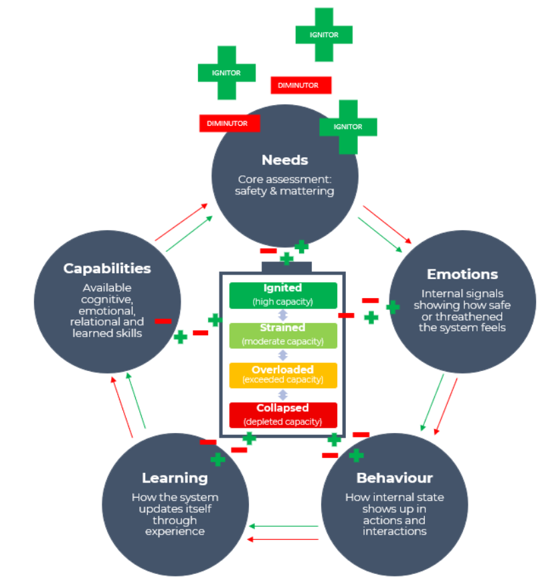
The Ignited Model explains how everyday external signals shape human capacity. The nervous system interprets these signals as either positive (ignitors) or negative (diminutors).
Ignitors strengthen the core needs of safety and mattering, creating an upward cycle that supports emotional stability, clarity, collaboration, and high performance. Signals such as clear communication, recognition, and consistent leadership act as ignitors by reinforcing these needs.
Diminutors have the opposite effect. They weaken safety and mattering, triggering a downward cycle that pushes people into Protection Mode and reduces capacity. Ambiguous decision‑making, chronic overload, or lack of acknowledgement are common diminutors that narrow perspective and limit access to emotional stability and higher-order thinking.
People have many psychological needs, yet signals that influence how safe and valued they feel tend to have the strongest and most immediate impact on whether capacity opens or contracts.
Crucially, these signals do not change behaviour directly. They shift the psychobiological state, determining whether people can access their collaborative potential and best thinking, or whether they become reactive, constrained, and focused on short-term survival. These shifts set the conditions for how people feel, think, and respond, a process made visible in the Inner Loop.
The Inner Loop: From Needs to Capabilities
Within each person, signals move through a dynamic loop involving needs, emotions, behaviour, learning, and capabilities. When needs are met or threatened, they generate emotional responses that shape how secure or valued someone feels. These emotions influence behaviour, which in turn drives learning as individuals update their responses based on experience. This learning improves or limits capabilities, cognitive, emotional, relational, and practical, which ultimately affect whether core needs are met in the future. The balance of ignitors and diminutors effectively charges or drains the human battery, determining how much potential is available at any moment.
Four Observable Capacity States
These internal shifts show up as four capacity states:
Ignited: Individuals and teams operate at their highest potential. Communication is open and empathetic, perspective-taking is strong, and co-creation flourishes. Capabilities such as self-awareness, self-regulation, and empathy are fully accessible, enabling clarity, creativity, and resilience for sustained high performance and innovation.
Strained: People experience reduced creativity, shorter patience, and diminished capacity for complex problem-solving. The ability to communicate openly, take others’ perspectives, and show empathy begins to erode. Collaboration and co-creation become more difficult as teams operate with less margin and struggle to move beyond routine tasks. Skills such as self-awareness and self-regulation are present but less consistent, making it harder to navigate interpersonal dynamics.
Overloaded: Emotional reactivity becomes prevalent, higher-order thinking contracts, and decision-making shifts to the short term. Communication breaks down, empathy and perspective-taking are limited, and teams find it increasingly difficult to collaborate or co-create. Capabilities are compromised; self-regulation falters, and self-awareness narrows, leading to reactive behaviours and strained relationships. The focus turns from strategic objectives to immediate survival, often at the expense of long-term value.
Collapsed: Motivation, communication, and energy drop sharply as the system shifts into self-protection mode. Individuals may withdraw from work and colleagues, exhibit increased absenteeism or sick leave, and display classic signs of burnout. Empathy and perspective-taking are minimal, and capabilities are largely inaccessible. The primary focus becomes conserving remaining energy, making meaningful collaboration or co-creation nearly impossible.
Across this continuum, ignitors move people upward, and diminutors pull them downward. These four states make psychobiological shifts visible, giving leaders a practical way to spot capacity early and intervene to restore conditions for growth, preventing deeper drops in performance.
Why People Break- and Recover
Performance decline happens quickly because the autonomic nervous system is wired for urgent protection. When people encounter overload, ambiguity, relational friction, or a lack of mattering, their capacity narrows, leading to reactivity, reduced collaboration, and short-term decision-making. This contraction doesn’t just affect individuals; it undermines innovation and consistent performance across teams.
Modern work environments amplify this mechanism. Digital overload fragments attention, constant comparison erodes mattering, and rapid change increases uncertainty. Many operate in a state of chronic low-grade threat, enough to keep the nervous system vigilant and push more people into Protection Mode, limiting available capacity and performance.
Recovery, by contrast, is slow and nonlinear. The autonomic nervous system must relearn that conditions are safe enough to reopen, oscillating between contraction and expansion as it tests for reliability. This is not failure, but biology recalibrating.
Teams that understand this dynamic build cultures that are steadier and more resilient. Leaders who recognise the difference stop expecting linear improvement and start designing conditions that support gradual, sustainable reopening of capacity and high performance.
By unifying diverse scientific insights, the Ignited Model explains why capable people thrive in some environments and struggle in others. It reframes behaviour as psychobiology in context, not just motivation or character, and highlights the leadership practices that help people stay in higher-capacity states. Understanding the model is only the first step; the real impact comes from how leaders apply it through the signals they send, the steadiness they bring, and the social environments they shape.
What Leaders Can Do
While leaders cannot control the challenges employees face outside the organisation, they retain significant influence over the signals and environment within it. By intentionally shaping the workplace climate, leaders can buffer the impact of external signals and enable people to access more of their capacity- even in difficult times. Increasing awareness among employees about these psychobiological dynamics empowers them to better manage their own state of mind, both at work and beyond. For this reason, awareness training is a powerful first step. The implications for leadership are both profound and practical. Every workplace functions like a nervous system, and leaders influence capacity through the signals they send, the steadiness they bring, and the environments they shape. The steps below outline a clear sequence leaders can follow to translate these insights into concrete actions that build capacity and resilience across their organisations.
1. Build Awareness
Leaders must start by raising awareness, both in themselves and across their teams, about how safety, mattering, and social environments shape human capacity. This includes helping people recognise their own states and understand how the environment impacts performance. Awareness training and open dialogue are essential first steps.
2. Diagnose the System
Effective leaders systematically assess where signals of safety and mattering are strong or weak, using tools such as regular check-ins, feedback sessions, and climate surveys. The goal is to identify root causes of disengagement or stress, not just to address symptoms.
3. Shift and Embed High‑Quality Signals Through Practice and Design
Once leaders understand the system, the next step is to intentionally shape the environment so that safety, mattering, and clarity are reinforced every day. This requires two moves: shifting the social signals people experience in the moment and embedding those signals in the organisation’s routines and structures so they become self-sustaining. Equally important is eliminating the ambiguity, inconsistency, and mixed messages that quietly erode trust and cognitive capacity.
To make these improvements durable, leaders must ensure that the organisation’s design supports them: simplifying workflows, clarifying decision roles, and establishing norms that encourage respectful dialogue and inclusive contribution. When daily behaviours and structural expectations reinforce the same message, teams experience a stable environment where clarity, collaboration, and high performance can take root and endure.
4. Lead with Steadiness, Self-Awareness, and Authenticity
Leaders who understand their own internal states can regulate effectively, stay grounded under pressure, and model the steadiness their teams rely on. By cultivating cultures of connection, presence, and respect- where individuals feel listened to, valued, and empowered to contribute, leaders create an atmosphere of trust and psychological safety. When leaders are open about challenges, acknowledge setbacks, and respond with clarity rather than reactivity, they signal that it is safe to contribute, take thoughtful risks, and innovate. In addition, leaders who prioritise service and contribution inspire teams to move beyond individual achievement toward collective success. By modelling proactivity and encouraging the development of both cognitive and emotional capacities, they create the conditions for sustainable, high-performing cultures.
These steps do more than strengthen individual teams; they signal a broader shift in organisational design. As demands on people continue to rise, the question is no longer whether safety and mattering matter, but how far leaders are willing to go to build systems that truly unlock human capacity and sustainable performance.
The Future of Human Capacity
The environments we move through, like workplaces, schools, cities, and digital platforms, were not designed with human psychobiology in mind. Most were built for industrial efficiency, not emotional sustainability. Yet science is now clear: people rise when their social environments support safety and mattering, and they fall when those needs are not met. As cognitive demands increase and complexity accelerates, the organisations that thrive will be those that align their design with how humans actually function.
The next era of leadership will be defined by those who understand that human capacity is not a resource to be extracted, but a potential to be unlocked. Leaders who intentionally foster cultures grounded in connection, presence, and respect- and who encourage every individual to bring their full intellectual, physical, and emotional selves to work- will set the standard for sustainable performance. By designing social environments where people can thrive without burning out, contribute proactively, and experience genuine belonging, these leaders will shape the future of work and set a new standard for sustainable performance.
The call is clear: Don’t settle for systems that drain potential. Build organisations where every signal- through words, actions, and culture- communicates:
You are safe. You matter.
When leaders make this their standard, they do more than improve results; they unlock the full potential of human capacity and elevate performance to new heights.
